Apex · the release orchestrator
“We want our developers to use Apex, not touch GitHub Actions directly.”
release lead, financial research firm, 1,500 pipelines

A CI migration should not turn developers into release engineers. Apex plans, gates, approves, deploys and backs out every release over the CI and tools you already run, and produces the audit evidence as it goes.

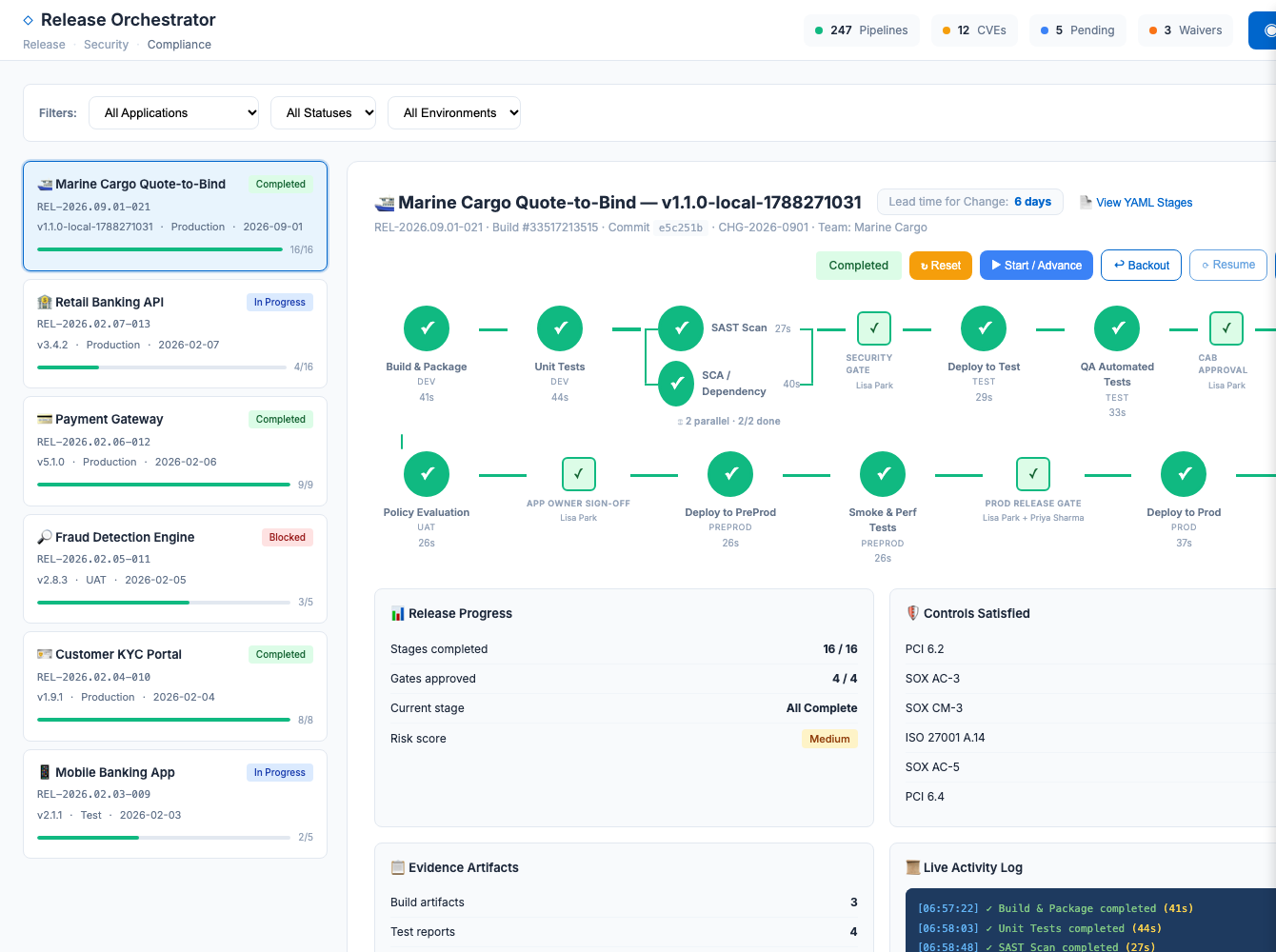
a release on the live demo environment · sixteen stages, four signed gates, one-click backout, hash-chained audit
the problem Apex solves

Ten tools. One screen. Nothing replaced.

A release today crosses GitHub Actions, scanners, ticketing, artifact stores and chat, with one person stitching it together by hand. Apex sits over all of them.

Every CI vendor wants to be the kernel. We never will be. Harness asks you to move or wrap your pipelines into it. Apex points at what you already run; the plan, approvals and evidence sit over all of it.
Apex

Plan, gate, approve, deploy, back out. Evidence produced as it runs.

Apex release orchestrator: a 16-stage release with parallel scans, human gates and backout
Release orchestrator · sixteen stages, four signed gates, the controls each satisfies, the live log
  • One release plan across every CI and tool, with parallel scans fanning into one security gate.
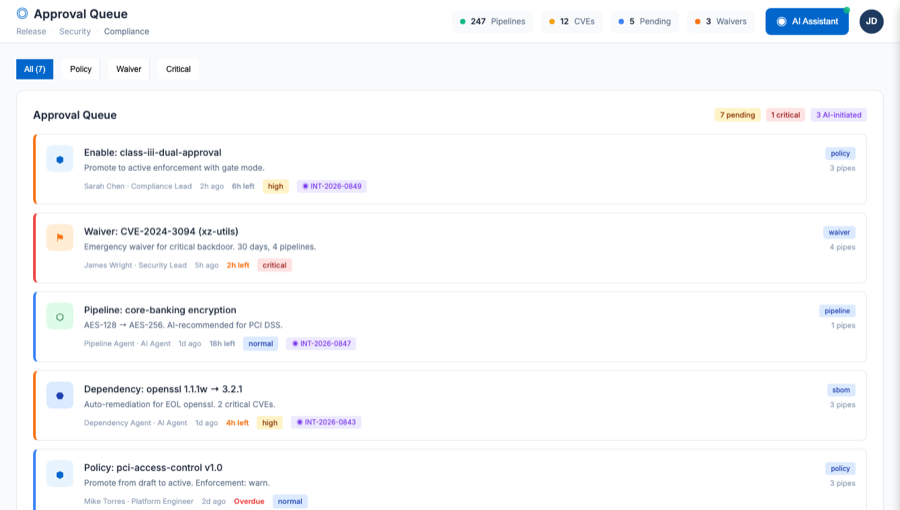
  • Signed human gates: app owner, CAB, production release. Separation of duties checked, fail-closed.
  • One-click backout, dynamic environments, same-version redeploy. What the CI alone does not give you.
  • Policy in English, compiled to deterministic, versioned Rego. Nothing a model writes runs unreviewed.
  • Audit evidence by default: every event hashed and chained, one evidence package per release, replayable years later.
Approvals · separation of duties, e-signature, fail-closed
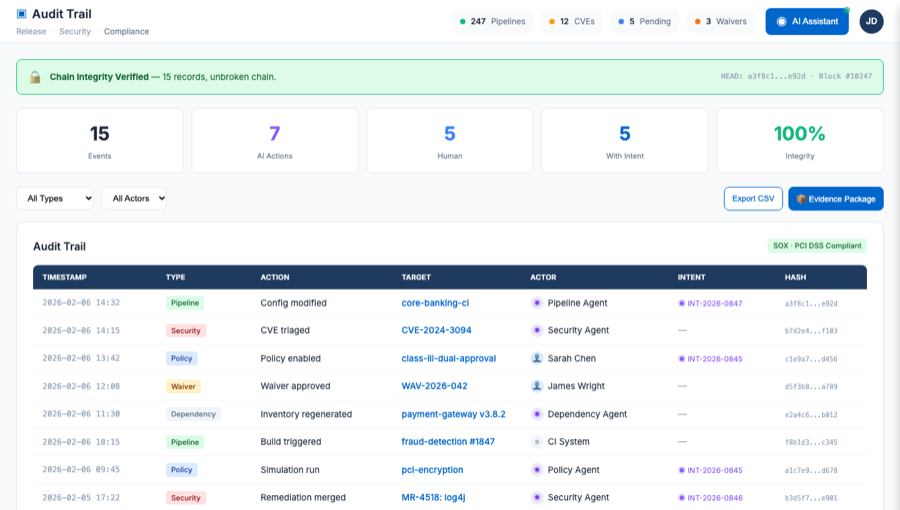
Audit trail · hash chain, evidence package export
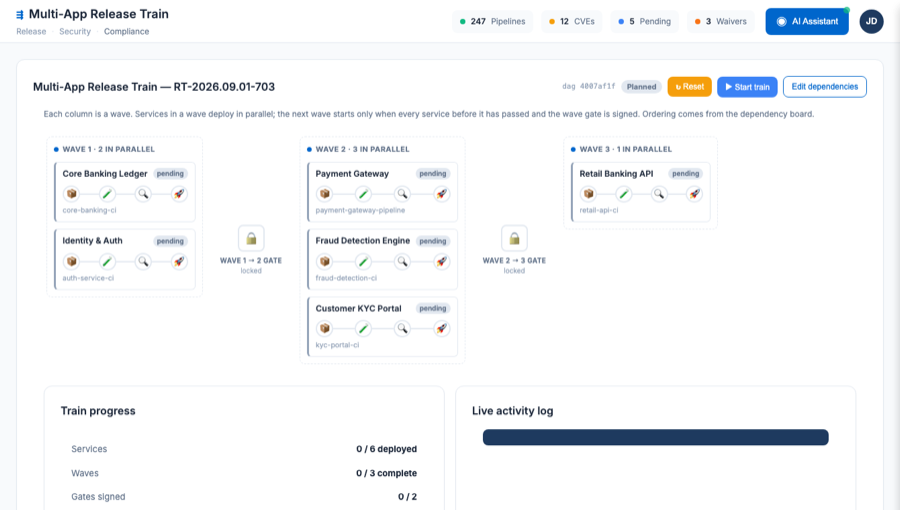
Release trains · multi-app waves, cross-app dependencies

Integrations: GitHub Actions · GitLab · Azure DevOps · Jenkins · GoCD · Harness · SonarQube · Veracode · Trivy · Snyk · OPA · ServiceNow · Jira · Nexus · Artifactory · Vault · Datadog · Splunk · PagerDuty · Slack · Teams · Okta

Dagly

CI migration, verified pipeline by pipeline.

GoCD, Azure DevOps and Jenkins estates converted to GitHub Actions or Harness. Each converted workflow runs on the same commit as the original and the results are compared. What cannot be proved is refused, with the reason, never approximated.

Converts

Definitions, faithfully

Stages, jobs, task order, templates, parameters, variables at every scope, secrets, materials, approvals, timers, artifacts and dependencies, each a recorded mapping.

Proves

Same commit, same result

The old pipeline and the converted workflow run side by side; artifacts are compared; pass or fail is reported per pipeline.

Hands over

Apex on top

The migrated estate arrives with a release plan, gates and evidence already in place, so developers never write workflows by hand.

why Mesolite

One core. Many needles.

Mesolite is a mineral that grows as fine needles radiating from one point. The company is built the same way: one Turing-complete transform engine, where data pipelines, integrations and microservices are different transforms on the same engine, with the products growing onto it. Apex’s chat reports run on it today; its services move onto it next. No Java or Python escape hatch; any logic stays in the engine. Built for regulated enterprises, where every release is also a compliance event.

Talk to us
DORA
approver and implementer independent, security checks verified, produced by the release itself
SOX
change evidence that proves it is complete, from the systems where changes actually ran
FDA Part 11
attributable electronic signatures and audit trails on every gate
contact

See a real release run, on the tools you already own.

A live walkthrough takes twenty minutes. Bring your CI and your audit findings.